01
Move
Explore the key areas that contribute to an efficient rotational movement strategy.
Rotational PowerpointsIndividual golf fitness and physical-performance profiling for golfers in Livingston, West Lothian—providing a clear route towards better movement, strength and performance on and off the course.
Golf places individual demands on every player. The profiling session identifies the physical qualities that currently support your game, the areas with room to develop and the priorities that matter most. It turns assessment data into a practical plan—without reducing you to a single score.
Each stage builds a fuller picture of your current physical profile and informs the coaching that follows.
Explore the key areas that contribute to an efficient rotational movement strategy.
Rotational PowerpointsMeasure how effectively you express force quickly and identify your power potential.
Jump, throw & speed dataSelect meaningful strength exercises and establish clear starting measures.
KPI LiftsConnect the findings to a focused physical-development plan for your golf and daily life.
Your coaching pathwayYour Rotational Powerpoints are the key physical areas that help you create and control rotation: the hips, thoracic spine, shoulders and neck, supported by golf posture.
We assess how each area moves in relation to useful targets. This highlights where movement is already serving you well and where a focused intervention may open up better options.
Club-head speed relies on more than effort. You need the capacity to produce force and express it quickly through the body.
Jump, medicine-ball throw and driver-speed measures help us understand your current power profile. Comparing different qualities can reveal whether your next opportunity lies in building more force, improving the speed of force expression or applying intent more effectively.
Your KPI Lifts are the main strength exercises selected to match your movement ability, training experience and goals. They give us practical measures of lower-body, unilateral and upper-body force capacity.
These are not chosen because every golfer should lift in the same way. They are selected because they are appropriate for you, measurable over time and useful within your wider programme.
The trunk helps transfer and control force between the lower and upper body. Capacity tests look at how well you can resist unwanted rotation, extension and lateral movement while maintaining useful positions.
Measures such as the split-kneeling Pallof press and selected trunk endurance tests create a practical baseline. The goal is to identify sufficient capacity for your golf, training and everyday demands—not to chase fatigue for its own sake.
Following the session, your results are organised within the In Swing Performance Player Dashboard. It shows your starting profile clearly, explains what the measures mean and highlights the physical priorities that can have the greatest influence on your development.
Future reviews are compared with your baseline, allowing you to see how your movement, power, strength and trunk capacity change over time.
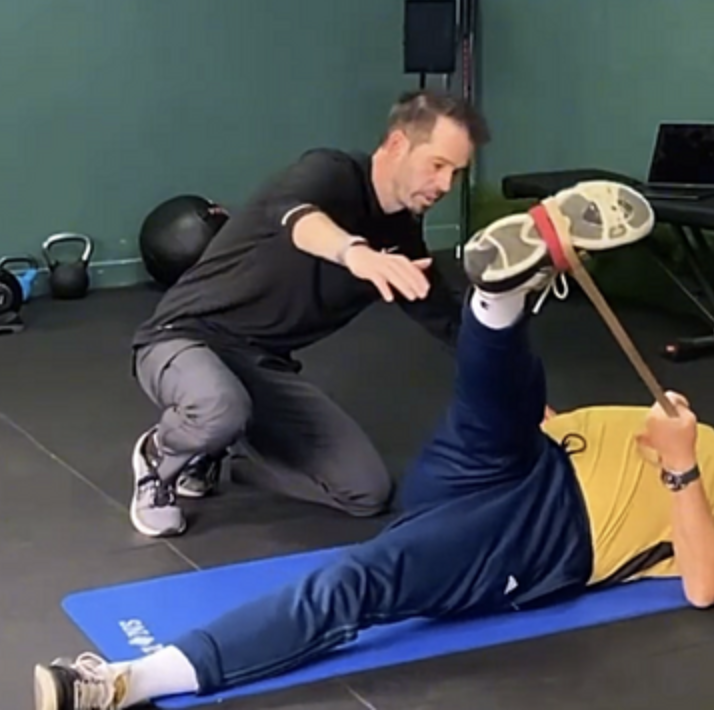
Over the last 25 years, I have worked across golf, fitness education and sports performance. Those experiences ultimately led me to create In Swing Performance.
My early career as an assistant golf professional showed me how often golfers were limited by poor movement, insufficient strength and recurring physical discomfort. The golfer’s physical capacity was frequently overlooked.
I subsequently spent several years coaching and educating future fitness professionals, personal trainers and sports coaches. Today, I work exclusively with golfers through individual strength and conditioning.
My Strong Long Golf philosophy is about more than hitting the ball further. It means developing a stronger, more capable and resilient body—one that supports your golf and your life away from the course.
You can expect honest coaching, clear structure and a practical plan centred on your body, experience and playing aspirations.
Every golfer starts from a different place. These results show what focused assessment, individual programming and consistent coaching can help unlock.
“I now play golf pain free and my mobility has improved dramatically for golf. The programme really helped to keep me on track.”
“After just a few weeks I saw substantial gains in the gym which began to translate to the course.”
“My swing speed is 5 mph faster than before. I like to work out at home and my sessions are set up for this.”
Individual results reflect each client’s starting point, goals and consistency.
The profiling session can stand alone, but its greatest value comes when the findings guide a progressive coaching process.
Hands-on coaching for golfers who value face-to-face support, immediate feedback and a structured training environment.
A personalised programme with remote support for golfers who need flexibility without losing individual direction or accountability.
Start with a clear understanding of your current physical profile. Leave with meaningful results, focused priorities and a route forward that fits your body, your golf and your life.
Profiling identifies physical-development opportunities and does not diagnose injury or replace medical assessment.